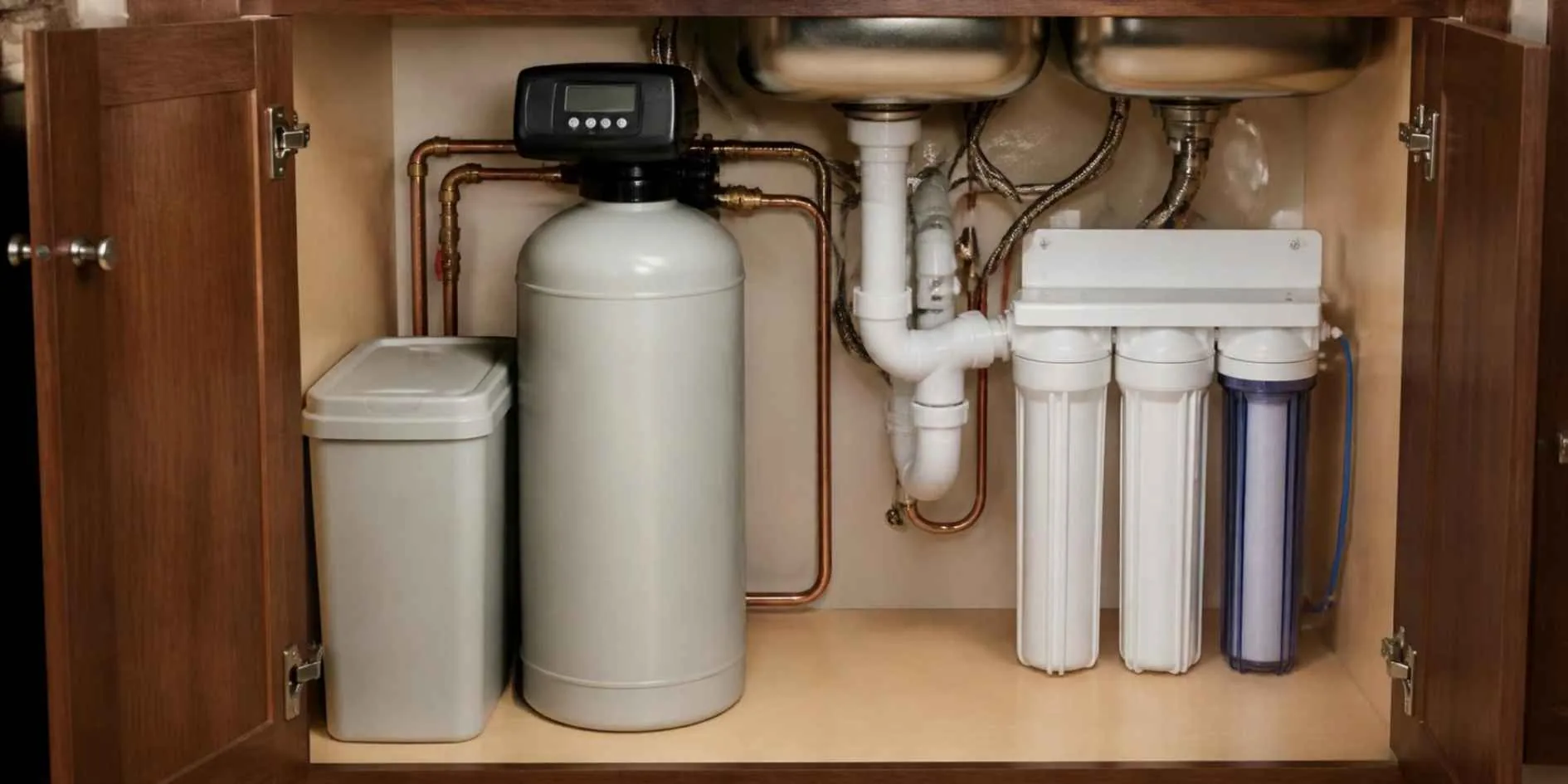
Softeners and filtration systems get lumped together often, but they solve genuinely different problems, and installing the wrong one for your actual concern means spending money without fixing what's actually bothering you.
What a Softener Actually Does
A water softener removes calcium and magnesium, the minerals that make water hard, through an ion exchange process. In Tempe, where hardness averages 15 grains per gallon according to the city's own water quality data, a softener is the direct answer to scale buildup, fixture spotting, and the accelerated water heater wear that hard water causes. It does not address taste, odor, or chlorine, that's a separate category of water quality entirely. See our water softener page for installation specifics.
What Filtration Actually Does
Filtration targets taste, odor, and specific contaminants, entirely separate from hardness. If your concern is chlorine taste at the tap rather than scale on fixtures or a water heater failing early, filtration is the relevant category, not softening. Our water filtration page covers the range of options from under-sink to whole-home systems.
A Simple Way to Tell Which You Need
If your complaint is white, chalky buildup on fixtures, soap that won't lather well, or a water heater that seems to fail early, that's a hardness problem, and a softener is the direct fix. If your complaint is how the water tastes or smells, particularly a chlorine taste, that's a filtration problem, and a softener won't touch it.
Many Tempe households genuinely have both concerns simultaneously, given the combination of real hardness and municipal chlorine treatment, which is exactly why combined softener-and-filtration installations are common here rather than unusual.
Making the Decision Without Overspending
Start with whichever problem is actually bothering you day to day rather than installing both preemptively. A household purely focused on protecting a new water heater and fixtures from hardness can reasonably start with just a softener and add filtration later if taste becomes a separate concern, or the reverse.
A Household Example to Illustrate the Difference
Consider two Tempe households with different complaints. One notices white buildup on shower fixtures and a water heater that failed years earlier than expected, that's a hardness problem calling for a softener. The other has no fixture buildup at all but finds the tap water tastes noticeably like chlorine, that's a filtration problem, and a softener would do nothing to address it. Matching the fix to the actual symptom, rather than installing whichever system a given retailer happens to promote, is what actually solves the problem.
A Note on System Maintenance for Either Choice
Neither a softener nor a filtration system is install-and-forget. A softener needs its salt supply replenished and, eventually, its resin bed serviced. Filtration systems need filter changes on their own schedule, more frequent for a heavily used under-sink system than a whole-home unit treating less concentrated flow at a single point. Factoring ongoing maintenance into the decision, not just the upfront installation cost, gives a more complete picture of what each option actually involves over time.
What Renters and Landlords Should Consider Differently
A homeowner planning to stay long-term can justify either investment against years of accumulated benefit. A landlord weighing the same decision for a rental property should think about it differently. The benefit, protecting appliances and fixtures from hardness or improving tenant-facing water quality, needs to show up as reduced maintenance calls and tenant satisfaction, a different calculation than a purely personal-use decision.
A Final Practical Note
Neither system is a one-time purchase in the way a new faucet is. Both come with an ongoing relationship, salt refills and resin service for a softener, filter changes for filtration, that continues for as long as the system is in use. Choosing based on the problem you actually have, rather than which system sounds more comprehensive, leads to a decision you'll be satisfied maintaining for years rather than one you'll regret the upkeep on.
Still Not Sure? Start With What Bothers You Most
If you genuinely can't decide because both concerns feel present, rank them by which one you'd fix first if you could only address one this year. That's usually a clearer signal than trying to weigh both systems' technical merits against each other in the abstract, and it points to a starting point you can build on later if the second concern remains after the first is addressed.
Why This Confusion Is So Common in the First Place
Softeners and filtration systems are often sold by the same companies, installed in similar-looking equipment, and marketed with overlapping language about improving water quality, all of which makes it genuinely easy for two very different technologies to blur together in a homeowner's mind. Understanding that they solve fundamentally different problems, one mechanical and hardware-focused, the other about taste and specific contaminants, is the first real step toward making the right choice rather than the more heavily marketed one.
What a Combined System Actually Looks Like
For households that end up wanting both, a combined installation typically places the softener first in the water's path, treating hardness before the water reaches a filtration stage that then addresses taste and odor. This sequencing matters: filtration media can be affected by high mineral content, so treating hardness first often means better performance and longer life from the filtration component that follows it.
The Question to Ask Any Installer
Regardless of which system, or combination, you land on, ask directly what specific problem each component is meant to solve for your household. A vague answer that treats softening and filtration interchangeably is a sign worth pausing on, since a real assessment should be able to name your specific complaint and connect it to the specific technology that addresses it.
Common Questions
Yes, combined installations are common and often more cost-effective than installing each separately at different times, since some labor and access work overlaps.
Not meaningfully. Softening addresses hardness minerals, not the chlorine taste or odor that filtration specifically targets, so a softener alone won't solve a taste complaint.
Generally no, standard filtration, whether under-sink or whole-home carbon filtration, isn't designed to remove hardness minerals the way an ion-exchange softener is.
It depends on which problem is actually affecting you. If you're seeing real hardware damage, water heater issues or fixture scale, prioritize the softener. If your primary complaint is taste or odor at the tap, prioritize filtration instead.
Household size affects sizing and cost more than which category you need, since a larger household puts more water through either system and may need a higher-capacity unit, but the underlying choice between softening and filtration still comes down to which problem you're solving.
Have This Problem In Tempe?
Call now for a real diagnosis and a flat price before any work starts.
☎ Call (480) 741-9332