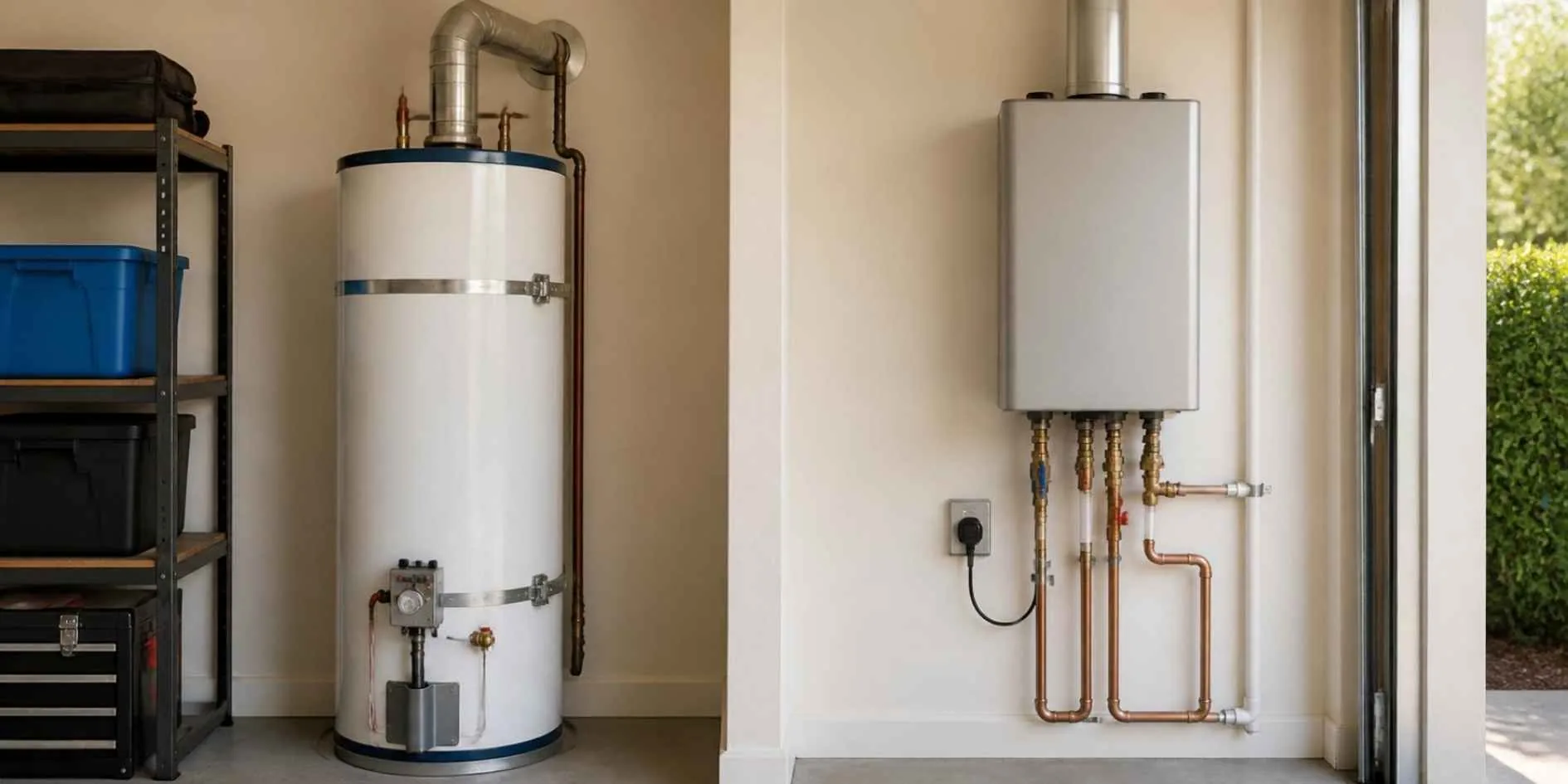
The tank-versus-tankless decision gets a lot of generic advice online, but Tempe's specific water quality genuinely changes the calculation for both options. According to the City of Tempe's own water quality data, hardness here averages 15 grains per gallon, and that mineral load doesn't disappear because you switched to a different kind of water heater.
How Hard Water Affects Each Option Differently
A tank-style unit collects sediment at the bottom as hardness minerals separate out during heating, which is why a six-month flush schedule matters more in Tempe than the national annual-flush default. Left unaddressed, that sediment layer shortens the unit's working life and eventually contributes to tank corrosion.
A tankless unit doesn't have a tank bottom for sediment to settle in, but its narrow heat exchanger scales up with the same minerals, just in a different location. That's why tankless units in Tempe need a descaling flush, ideally every six months without a softener, rather than the once-a-year interval that's reasonable in softer water.
The Real Cost Comparison
Tankless costs more upfront, both for the unit and installation, but uses less energy over time since it doesn't keep a large volume of water hot around the clock. Tank units cost less initially but have a shorter typical lifespan in hard water conditions, especially without regular maintenance.
A whole-home water softener changes this math for either choice. Softened water dramatically slows scale buildup in both a tank and a tankless heat exchanger, which is worth factoring in if you're weighing a softener alongside a new water heater rather than treating them as unrelated decisions.
Which Homes Tend to Prefer Which Option
Households with high simultaneous hot water demand, multiple bathrooms running at once, for example, tend to prefer tankless for its continuous supply. Households prioritizing lower upfront cost, or planning to install a softener regardless, sometimes find a well-maintained tank unit perfectly reasonable. Neither is a wrong answer. It depends on real usage patterns, whether a maintenance schedule will actually be kept, and in a rental-heavy area like West Mesa, on how quickly a failure actually gets reported. See our water heater installation page for a closer look at sizing and installation specifics.
Installation and Maintenance Differences Worth Knowing
A tankless installation is more involved than a tank swap, sometimes requiring updated venting or gas line sizing to meet the unit's higher demand, which is part of why upfront installation cost runs higher even before comparing the units themselves.
On the maintenance side, a tank unit's flush is a simpler, faster task that many homeowners handle themselves. A tankless descaling flush, circulating a cleaning solution through the heat exchanger, is a bit more involved and is where a lot of tankless owners either fall behind on schedule or bring in a professional for the service.
What Happens If Maintenance Gets Skipped Either Way
A tank unit that never gets flushed will eventually fail from sediment buildup and, often, tank corrosion, typically years earlier than its rated lifespan. A tankless unit that never gets descaled will show declining flow and temperature consistency first, then start throwing error codes, and can eventually suffer heat exchanger damage that's far more expensive to repair than a routine descale would have cost.
Neither type of water heater is maintenance-free in Tempe's water, which is really the core point: the choice between tank and tankless is less about which one avoids maintenance and more about which maintenance rhythm fits how the household actually operates.
A Reasonable Way to Decide
If you already know a maintenance schedule realistically won't get kept, a tank unit's simpler, more forgiving flush routine is the more honest choice, even accounting for its shorter typical lifespan in hard water. If continuous hot water for a larger household matters more, and a service reminder or a standing maintenance arrangement will actually keep the descaling on schedule, tankless can deliver real value over its longer working life.
Questions Worth Asking Before You Decide
How many bathrooms will realistically run hot water at the same time in your household, and how often? Is a whole-home softener already installed or genuinely likely to be added soon, which changes the maintenance math for either option? Is there an existing gas line and venting configuration that suits tankless, or would switching mean a more involved installation? Answering these honestly, rather than defaulting to whichever option a specific retailer happens to be promoting, leads to a choice that actually fits the household rather than a generic recommendation.
What This Looks Like for a Typical Tempe Household
A single-family home with two bathrooms and a household of three or four people is a common profile in Tempe, and for that profile, either option can work well depending on priorities. A household that's already dealt with a tank failure and wants to avoid a repeat, or one planning to stay in the home long enough for tankless's longer lifespan to pay off the higher upfront cost, tends to lean tankless. A household prioritizing lower upfront cost, or renting out the property and wanting a simpler system for a property manager to maintain, often finds a well-maintained tank unit the more practical choice.
The Bottom Line
Neither option is a universal right answer in Tempe. The honest comparison isn't tank versus tankless in the abstract, it's which unit fits your household's actual hot water demand and which maintenance schedule you'll genuinely keep, given how much Tempe's water shortens the consequences of skipping either one. Get the maintenance schedule right and either choice holds up well here, for years.
Common Questions
It can, but only if the descaling schedule is actually kept. A neglected tankless unit in Tempe's water loses efficiency and can fail early, the same way a neglected tank unit does, just through a different mechanism.
For many households, yes. A softener slows the mineral scale buildup that affects either type of water heater, which can meaningfully extend the unit's working life regardless of which one you choose.
It varies by household usage, but a tank that might last 10 to 12 years in moderate water often starts struggling by year 8 in Tempe without a softener or a consistent flush schedule.
Often, yes, though it depends on your home's existing gas line and venting. We assess this during installation planning rather than assuming every home can accommodate a tankless unit without changes.
Many manufacturers do specify a maintenance interval as a warranty condition, so it's worth checking your specific unit's documentation rather than assuming the general hard-water guidance alone satisfies the warranty terms.
Have This Problem In Tempe?
Call now for a real diagnosis and a flat price before any work starts.
☎ Call (480) 741-9332