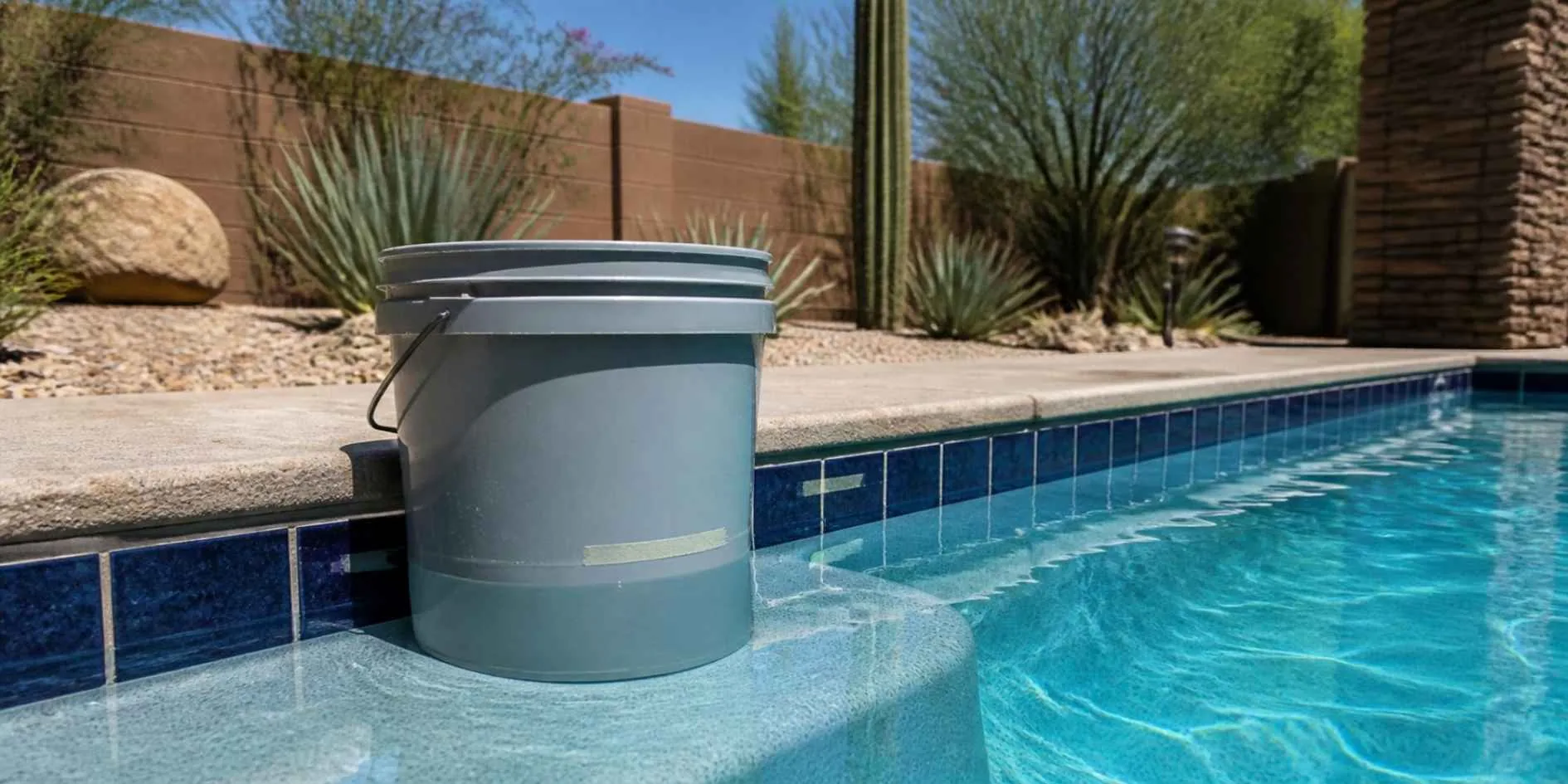
Tempe has one of the highest rates of backyard pools in the country, and with that comes one of the most common false alarms in pool ownership: mistaking normal desert evaporation for an actual leak. The good news is that telling the difference takes a simple test anyone can run at home.
The Bucket Test, Step by Step
Place a bucket on a pool step so the water level inside the bucket matches the pool's water level. Mark both levels with tape, then wait 24 hours. If the pool's level dropped noticeably more than the bucket's, water is leaving the system beyond what evaporation explains, and that points to a real leak.
If both levels dropped by roughly the same amount, what you're seeing is normal evaporation, which is genuinely significant in Tempe's dry heat and shouldn't be mistaken for a plumbing problem.
How Much Evaporation Is Actually Normal Here
Tempe's combination of low humidity, high summer temperatures, and wind can push evaporation to a quarter inch or more per day during peak summer months, which is a real, substantial amount of water loss with no leak involved at all. Homeowners new to pool ownership, or new to the desert, often assume this level of loss must mean a leak when it's actually expected.
A pool cover reduces evaporation loss significantly when the pool isn't in use, which is worth considering if water loss and the associated refill cost are a genuine concern separate from any leak question.
Once the Bucket Test Confirms a Real Leak
A confirmed leak beyond evaporation needs a real inspection to locate, since guessing at the source usually means chasing the wrong thing. Our pool leak detection page covers the actual detection methods, dye testing, pressure testing, and equipment pad inspection, once a leak beyond evaporation is confirmed.
The location matters for the fix. A skimmer line crack, an equipment pad fitting, and a shell crack are three genuinely different repairs with different costs, which is why detection always comes before a repair estimate.
A Note for Pool Owners in Golf and Lake Communities
Homes in Ahwatukee's golf-adjacent communities often have both a pool and nearby shared landscaping irrigation, which can make water-loss troubleshooting more complicated since both systems draw from water sources near each other. Isolating which system is actually losing water, the pool specifically versus a nearby irrigation line, is worth confirming before assuming the pool itself is the source.
A Second Test Worth Running: The Dye Test
Once the bucket test confirms a real leak, a dye test can help narrow down where. With the pump off and the water still, a small amount of dye released near suspected areas, a skimmer, a light fixture, a visible crack, will get drawn toward an actual leak point if one is there. Water flows toward the opening even without the pump running, which is what makes the dye visibly track the direction of the leak.
This is a genuinely useful step to try before scheduling a professional visit, since narrowing the likely area, even roughly, helps make the actual service call more efficient.
Why Evaporation Rates Change Throughout the Year
Evaporation loss isn't constant across the year in Tempe. Peak summer heat combined with low humidity and wind pushes rates to their highest point, while cooler, calmer months see meaningfully less water loss from evaporation alone. A pool that seemed stable in spring but starts losing more water in July isn't necessarily developing a new leak, it may simply be experiencing the season's higher evaporation rate. Re-running the bucket test seasonally, rather than assuming a single result applies year-round, gives a more accurate picture.
What a Genuinely Elevated Water Bill Alongside Pool Loss Might Mean
If your household water bill has also climbed alongside apparent pool water loss, it's worth considering whether the two are actually connected. A pool leak wouldn't typically show up on a separate household meter reading unless the pool draws directly from your home's own water supply for refills. Isolating whether the loss is genuinely pool-specific or part of a broader household increase helps avoid chasing the wrong system entirely.
When It's Worth Calling a Professional Rather Than Continuing to Test
If the bucket test has confirmed a real leak, and a dye test hasn't clearly pinpointed the source after a reasonable attempt, that's the point where professional detection equipment becomes worth the cost rather than continuing to guess. Pressure testing isolated sections of plumbing, something not practical without the right equipment, is often what finally narrows down a leak that visual inspection alone can't find.
Keeping a Simple Water-Level Log
Tracking your pool's water level at the same time each week, even with a basic mark on the skimmer or a phone note, builds a real baseline over the season. A single bucket test gives a snapshot, but a running log makes it much easier to notice a change in the rate of water loss over time, which can catch a slow, developing leak well before it becomes obvious enough to prompt a one-off test.
A Last Word on Not Overreacting
It's worth remembering that a pool losing some water every week is entirely normal in Tempe's climate, and the goal of these tests isn't to eliminate all water loss, that's not realistic here. It's to catch the difference between expected evaporation and an actual leak, so you're not paying to chase a problem that doesn't exist, or ignoring one that genuinely does, whichever direction the real answer turns out to be.
Common Questions
24 hours is the standard timeframe and gives a reliable comparison. If results seem ambiguous, running the test again for a full 48 hours can help confirm a borderline result.
No, a cover reduces evaporation but doesn't eliminate a leak if one exists. The bucket test is still the right way to distinguish reduced evaporation from an actual leak even with a cover in use.
Yes, and it's actually one of the more common sources. Pump, filter, and heater connections at the equipment pad are frequent leak points, often simpler and less expensive to fix than a pool shell or buried line issue.
A spa's higher surface-area-to-volume ratio and, if it's heated, warmer water temperature can both increase evaporation compared to the main pool, so somewhat faster water loss from a spa alone isn't automatically a leak.
Yes, wind increases evaporation for both the pool and the bucket similarly, so the comparison still holds, but running the test on a particularly windy day may show higher overall loss for both, which is normal and doesn't invalidate the result.
Have This Problem In Tempe?
Call now for a real diagnosis and a flat price before any work starts.
☎ Call (480) 741-9332