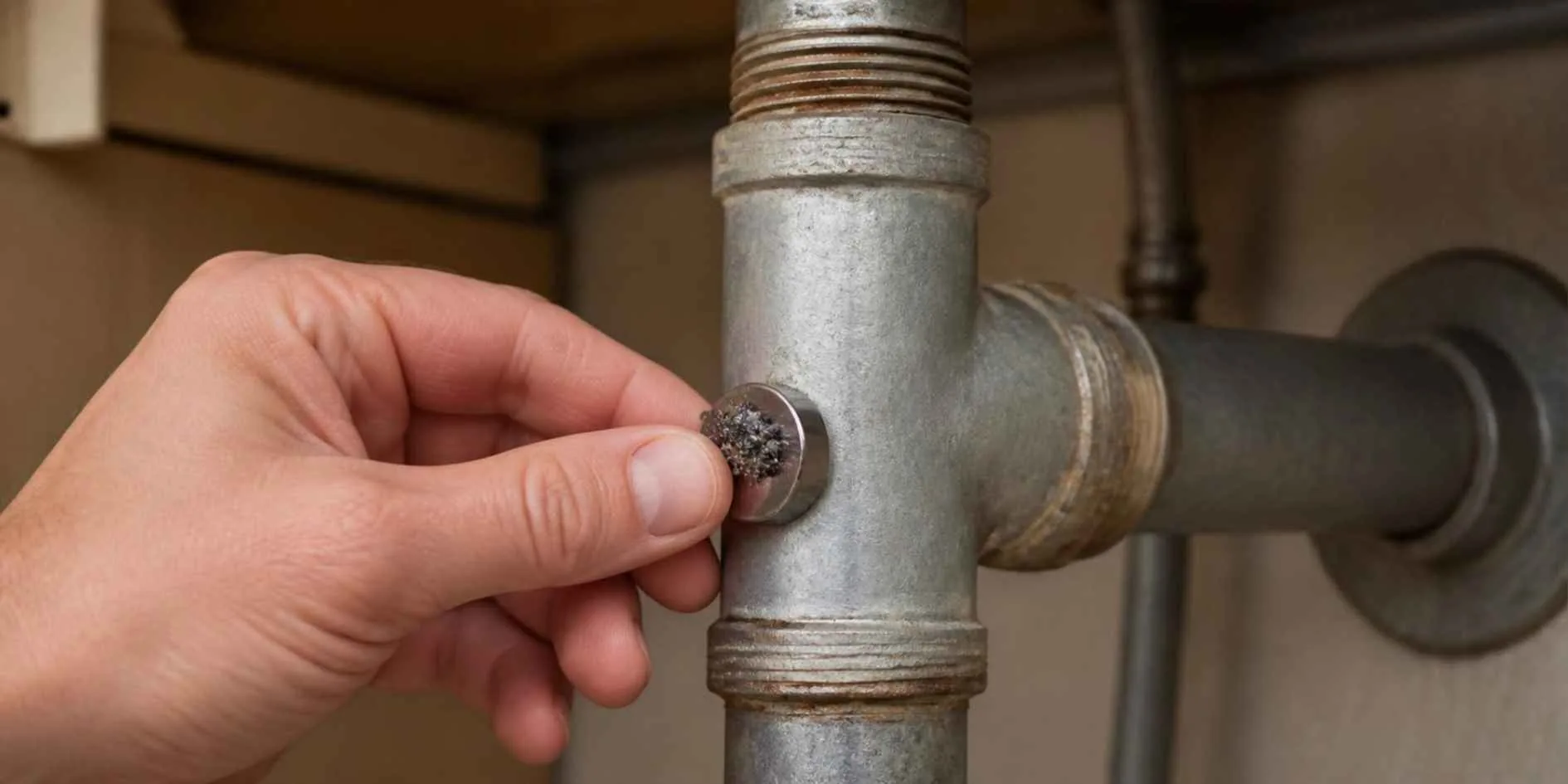
Galvanized steel pipe was standard in homes built before the 1960s, and in our service area, that means mostly South Scottsdale's mid-century housing stock, though some older pockets of North Tempe have it too. Knowing whether your home has it is the first step in deciding whether a repiping conversation is worth having.
A Simple At-Home Check
The most accessible place to check is usually at the water heater, where the connecting pipes are often visible. Galvanized pipe is typically dull gray and, unlike copper, will attract a magnet, a quick and genuinely reliable test since copper and PEX are both non-magnetic.
Another check is at an exposed pipe section in a garage, basement, or crawlspace, if your home has one. Galvanized pipe often shows visible corrosion or rust-colored buildup at threaded joints even when the pipe itself still looks structurally intact from a distance.
Symptoms That Point to Galvanized Pipe
Low water pressure that's developed gradually over years, rather than failed suddenly, is a classic sign of galvanized pipe corroding and narrowing from the inside. Rust-colored water, especially right after a faucet has sat unused for a few hours, is another strong indicator, since that's mineral buildup being disturbed after sitting still.
If these symptoms are isolated to hot water only, the corrosion may be concentrated in the water heater's connections rather than the broader system, worth distinguishing before assuming a full repipe is needed.
Why It Matters Once Confirmed
Galvanized pipe corrodes from the inside in a way that narrows the pipe with rust, not mineral scale, and once that process starts, it doesn't reverse. Unlike scale in copper pipe, which can sometimes be addressed with a water softener going forward, existing galvanized corrosion is permanent. Our repiping page covers what a full or partial replacement actually involves once you've confirmed the pipe material.
What a Repipe Actually Involves Once You've Confirmed It
Once galvanized pipe is confirmed, the practical question becomes whether to replace the whole system or just the sections showing the worst symptoms. A whole-home repipe with PEX or copper resolves the underlying cause everywhere at once, while a partial repipe targets only the sections causing active problems, leaving the rest for a later phase.
Access matters as much as material choice here. In a single-story home with an accessible attic, new lines can often be run with minimal wall openings. A multi-story home or one built on a slab typically needs more invasive access, which is worth understanding before committing to a full-home approach versus a phased one.
What This Costs to Ignore
Continuing to live with galvanized pipe doesn't just mean tolerating low pressure. As corrosion progresses, the risk of a sudden pinhole leak or a full pipe failure rises, and by that point you're dealing with an emergency repair and possibly water damage rather than a planned upgrade on your own schedule. Homes with confirmed galvanized pipe that haven't yet had a failure are, statistically, on borrowed time rather than in the clear.
A Real Example of How This Plays Out
A common pattern in South Scottsdale's mid-century homes looks like this: pressure has been gradually dropping for a year or two, dismissed as normal aging. Then a pinhole leak appears at a joint behind a wall, discovered only when a ceiling stain shows up below a second-floor bathroom. At that point, the homeowner is facing both an emergency repair and water damage cleanup, when a planned repipe identified a year earlier would have cost less overall and happened on a convenient schedule.
This is the real argument for checking proactively rather than waiting for a failure to force the issue. A magnet test and a look at the water heater connections takes a few minutes and costs nothing.
What To Do If You Find An Active Leak
If a galvanized joint is actively leaking, shut off the main water valve first, before anything else. Don't attempt to cut into or patch the line yourself, since corrosion in galvanized pipe rarely stays isolated to one visible point, and a temporary patch on a line that's failing elsewhere too just delays the same problem.
Document the leak's location and any visible corrosion with a photo before cleanup begins, since that's useful both for a contractor's assessment and for an insurance claim if the leak has caused any water damage.
What to Ask Before Committing to a Repipe
Before scheduling a full repipe, it's worth asking whether the whole system needs replacing at once or whether a phased approach makes more sense for your budget and timeline. It's also worth asking about material choice specifically for your home's layout, since PEX and copper have real trade-offs in cost and installation invasiveness that vary by house. A contractor who can answer both questions clearly, rather than defaulting to one standard package, is giving you a real assessment rather than a generic sales pitch.
How This Differs From a Simple Repair
A single pinhole leak, repaired on its own, addresses that one failure point and nothing else. If the rest of the galvanized line is at a similar stage of corrosion, which it usually is since the whole system was installed at the same time, that single repair doesn't buy much time before the next failure shows up somewhere else. This is the real distinction between patching galvanized pipe and actually solving the underlying problem: a patch treats the symptom, a repipe treats the cause.
A Note on Insurance and Galvanized Pipe
Some homeowner's insurance policies have started scrutinizing galvanized pipe more closely, occasionally requiring it be replaced as a condition of coverage or renewal, particularly in older homes. If you're not sure how your specific policy treats galvanized pipe, it's worth a direct conversation with your insurer, since a repipe undertaken proactively is a very different financial conversation than one forced by a claim after a failure.
The Bottom Line
A five-minute magnet test at the water heater is the cheapest, fastest way to know where you actually stand. Whether that leads to a full repipe now, a phased plan over a couple of years, or simply peace of mind that your lines are already modern, knowing the real answer beats guessing based on a home's age alone. Home age is a starting clue, not a diagnosis, and the only way to know for certain is to check.
Common Questions
Yes, it's a genuinely reliable quick check. Galvanized steel is magnetic; copper and PEX are not, so a magnet sticking to an exposed pipe is a strong, fast indicator.
Not necessarily. A partial repipe targeting just the galvanized sections is sometimes a reasonable option, though a full assessment of the whole system helps confirm whether that's the right call for your specific home.
It's the area with the highest concentration given its mid-century housing stock, but any home built before the 1960s anywhere in our service area could have galvanized pipe, worth checking regardless of the specific neighborhood.
You can, but that approach usually costs more in total than a planned repipe, since each emergency repair carries its own labor and access cost, and you're paying for that repeatedly instead of once.
Have This Problem In Tempe?
Call now for a real diagnosis and a flat price before any work starts.
☎ Call (480) 741-9332