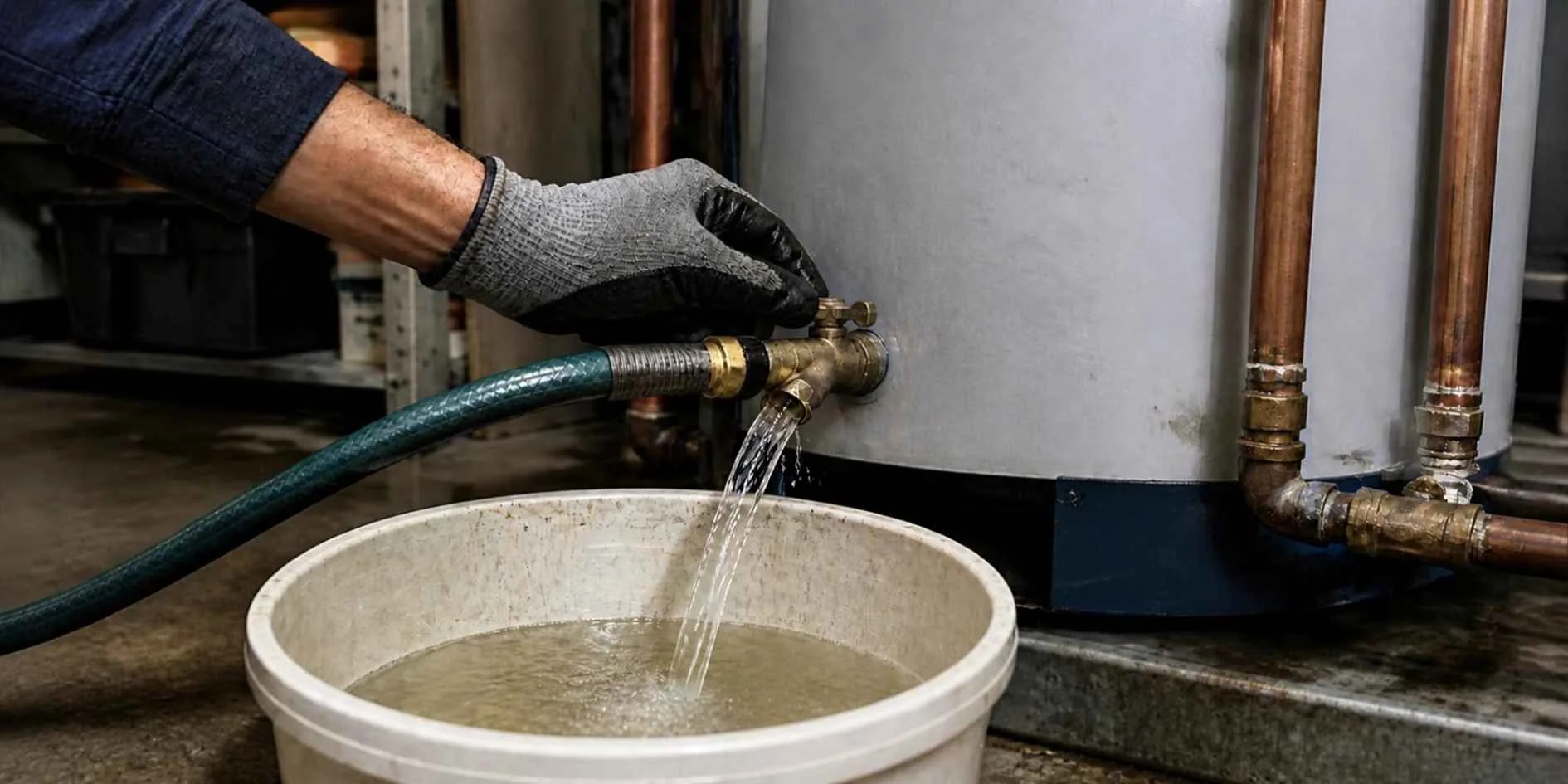
The standard advice for flushing a tank water heater is once a year. In Tempe, that advice needs an asterisk: with hardness averaging 15 grains per gallon according to the City of Tempe's own water quality data, once a year isn't enough. The realistic interval for most Tempe homes without a softener is every six months, and it's worth treating that as a calendar reminder rather than something to remember only once a symptom shows up around the house.
Why Hardness Changes the Schedule
A water heater flush exists to clear out the mineral sediment that settles at the bottom of the tank as hard water is heated. Calcium and magnesium separate out of the water and fall to the bottom, building into a hard, sand-like layer over time.
The general rule most plumbers and manufacturers use nationally is an annual flush, but that number assumes moderate water hardness. At Tempe's roughly 15 GPG average, sediment accumulates fast enough that stretching to a full year lets a genuinely thick layer form, one that's harder to clear and that's already been insulating the heating element from the water above it for months.
Signs You've Already Waited Too Long
A rumbling or popping sound during the heating cycle is the most common sign, and it's literally the sound of water boiling underneath a layer of sediment. Reduced hot water supply is another: sediment takes up real volume inside the tank, so a unit rated for 50 gallons might functionally behave like it holds less.
Rusty or discolored hot water is a more serious sign, since it can mean the sediment layer has progressed to actual tank corrosion rather than just loose buildup. At that point, a flush alone may not fix the underlying problem, and the honest conversation shifts toward whether the unit needs replacement.
What a Professional Flush Actually Involves
A flush drains the tank completely, using the drain valve to clear out settled sediment, sometimes with the water supply run briefly to help dislodge stubborn buildup. Tankless units use a different process entirely: rather than draining a tank, they need a descaling flush that circulates a cleaning solution through the heat exchanger to dissolve mineral scale.
Either way, the tell you're overdue is usually audible or visible before it's measured on a calendar, which is why a six-month interval in Tempe should be treated as a default, not a maximum.
Tank vs. Tankless: Different Maintenance, Same Root Cause
A traditional tank water heater and a tankless unit fail for related but distinct reasons in Tempe's water. In a tank, sediment settles by gravity to the bottom, where it sits directly against the heating element or burner, which is why a drain-and-flush from the bottom valve resolves it.
A tankless unit doesn't have a tank bottom for sediment to settle in, but it does have a heat exchanger with narrow internal passages, and those passages scale up with mineral deposits the same way a kettle does over time. That's why tankless maintenance is a circulated descaling flush rather than a simple drain, and why skipping it doesn't just risk noise or reduced capacity. It can restrict flow enough to trip the unit's internal safety sensors.
What Happens If You Skip It
The most immediate cost of skipping a flush is efficiency. A sediment layer acts as insulation between the heating element and the water, so the unit runs longer and uses more energy to reach the same temperature. Over time, that translates directly into a higher utility bill for the same amount of hot water.
The longer-term cost is the unit's lifespan itself. A water heater that's been let go for years in Tempe's hard water is a genuine candidate for early replacement rather than continued repair, since heavy sediment can also mask or accelerate tank corrosion. A flush that costs a fraction of a repair, done on a six-month schedule, is consistently the cheaper path over the life of the unit.
Where This Shows Up Most
This is a bigger deal in some parts of our service area than others, simply because of housing age. In Guadalupe, where a lot of units are original to homes built in the 1970s through the 1990s, a skipped flush schedule compounds with an already-aging tank in a way that shortens the remaining service life faster than it would in a newer home.
If you're not sure how old your own unit is, the manufacture date is usually stamped on a data plate near the top of the tank, and it's worth checking before assuming a recent-looking exterior means a recent installation.
Before You Flush: A Safety Checklist
A tank flush is a manageable task, but it involves hot water and, on a gas unit, a working knowledge of the pilot or ignition system, so a few real safety steps matter before starting.
Turn off the power to an electric unit at the breaker, or set a gas unit's control valve to pilot, before draining any water, so the heating element or burner never activates against an empty or partially empty tank. Give the water time to cool if the unit has been running recently, since draining scalding water through a garden hose is a real burn risk, not a theoretical one.
Attach the drain hose securely and route it somewhere the water can safely run off, a floor drain or outside, rather than across a finished floor. Once the tank is empty and refilled, check the drain valve itself for a slow drip, since an older valve can start leaking after being operated for the first time in years, which is worth catching before walking away from the job.
Common Questions
Yes. A whole-home water softener removes much of the hardness before it reaches the tank, which slows sediment buildup significantly and can let a household return to a closer-to-annual flush interval.
It's a common DIY task for a straightforward tank unit, but if the drain valve is corroded or the unit hasn't been flushed in years, a professional visit avoids turning a routine flush into an unplanned repair.
Often, yes, if the noise is from loose sediment. If the tank has already started corroding, a flush won't reverse that, and it's worth a real inspection rather than assuming a flush is the fix.
For a household planning to keep a tank-style unit long-term, a softener is a genuine way to extend its life by slowing sediment buildup at the source. It's a separate decision from the flush schedule itself, and worth weighing against its own upfront and maintenance costs.
Have This Problem In Tempe?
Call now for a real diagnosis and a flat price before any work starts.
☎ Call (480) 741-9332