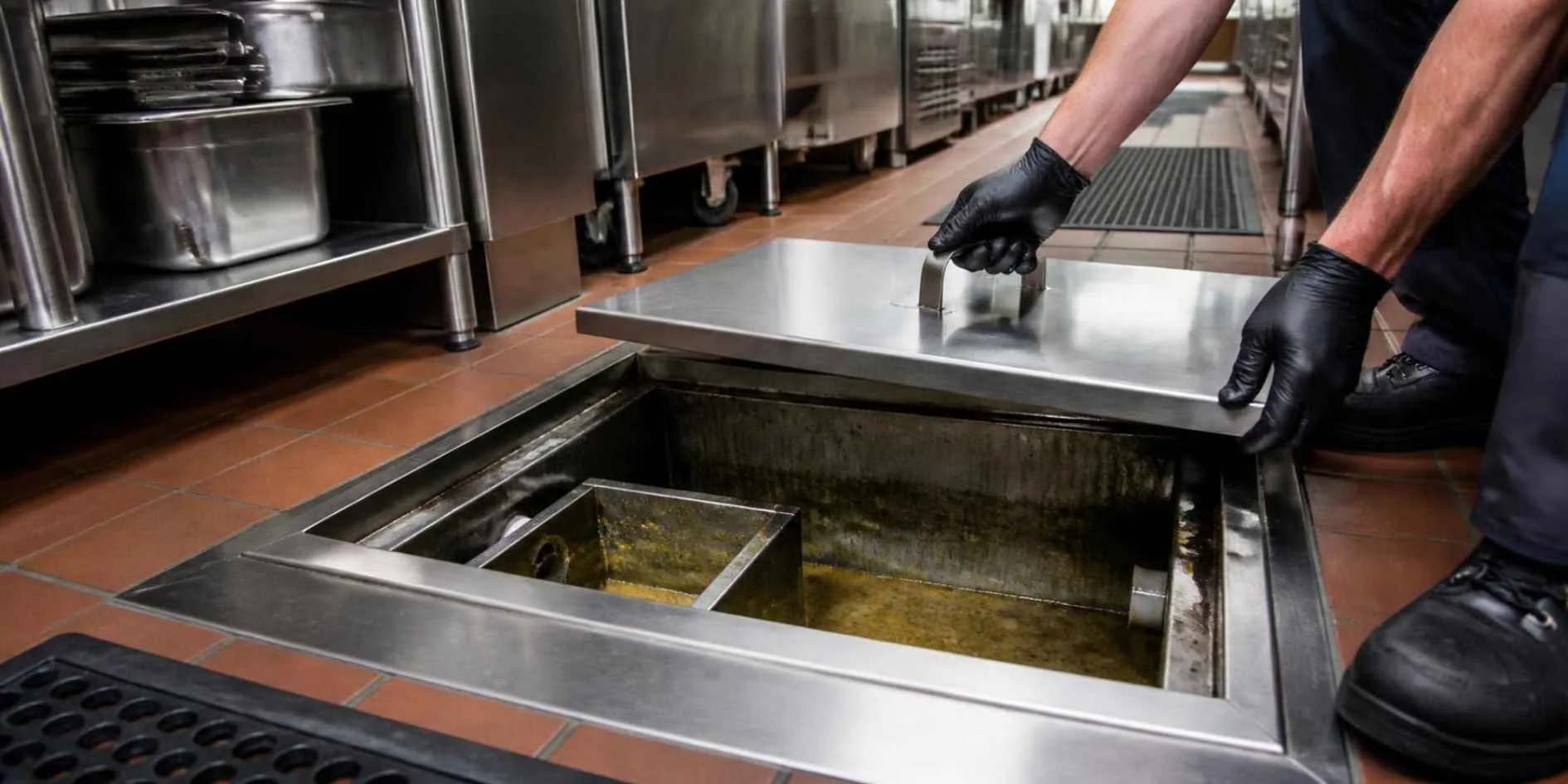
Tempe's Mill Avenue and ASU corridor has a real concentration of restaurants and food service businesses, and grease trap maintenance is one of the most consistently underestimated recurring costs in running one of them. Skipping it doesn't save money, it just delays a much larger bill.
Why Grease Traps Need Regular Service
A grease trap captures fats, oils, and grease before they reach the municipal sewer system, and it fills gradually with every load of dishes and every drain in the kitchen. Once it's full, grease starts passing through into the drain line itself, where it cools, hardens, and builds up exactly the kind of blockage that causes a kitchen-wide backup during a dinner rush.
This isn't just a plumbing inconvenience. According to most municipal cross-connection and grease management guidelines, including requirements that apply in Tempe, food service businesses are expected to maintain grease traps to prevent exactly this kind of backup. A failure that reaches the municipal system can carry real regulatory consequences beyond the immediate mess.
A Real Maintenance Schedule, Not a Generic One
How often a grease trap needs service depends genuinely on kitchen volume, not a flat industry default. A high-volume restaurant near ASU, especially one open for multiple daily meal periods, often needs monthly service, while a smaller retail food operation might reasonably stretch to quarterly.
Guessing at the interval and waiting for symptoms, slow drains, odor, is the expensive way to find out you guessed wrong. Our commercial plumbing page covers how we help establish the right schedule for a specific kitchen's actual volume.
What Happens When Maintenance Gets Skipped
A neglected grease trap eventually leads to a full drain line blockage, which almost always shows up at the worst possible time, mid-service, when the kitchen can least afford downtime. At that point you're looking at emergency hydro jetting to clear hardened grease from the line, a bigger and more disruptive job than routine trap service would have been.
Repeated neglect can also mean grease reaching the municipal line, which is the scenario that brings real regulatory and liability exposure on top of the plumbing cost itself.
Building This Into Restaurant Operations
Treating grease trap service as a fixed, recurring line item rather than a reactive call, the same way a kitchen budgets for pest control or fire suppression inspection, is the practical fix. A maintenance contract with a set schedule removes the guesswork and the risk of a mid-service emergency entirely.
How Staff Habits Affect the Real Schedule
Kitchen staff practices meaningfully affect how fast a grease trap fills, independent of raw sales volume. Scraping plates into the trash before washing rather than into the sink, and using a strainer on floor drains, both genuinely extend the interval between needed services. A restaurant with poor staff habits can outpace even a well-chosen maintenance schedule, which is worth addressing alongside, not instead of, the service interval itself.
What a Service Visit Actually Involves
A proper grease trap service pumps out accumulated grease and solids, not just a partial skim off the top, and includes a check of the trap's baffles and seals for wear. A trap that's only ever partially cleaned looks serviced on paper but continues filling faster than expected, which is why the thoroughness of the service matters as much as the frequency.
What to Look for in a Service Provider
A provider who documents each visit with a service record, useful for both your own tracking and any compliance inspection, is worth prioritizing over one offering only a verbal confirmation. Consistency matters too: the same provider on a set schedule builds familiarity with your specific kitchen's equipment and typical grease volume, which tends to catch developing issues faster than a rotating set of one-off providers would.
Planning Around Peak Seasons and Special Events
A restaurant that sees a genuine spike in volume during ASU's academic calendar, football season, or a specific local event should factor that into the maintenance schedule rather than sticking rigidly to a flat interval year-round. A trap serviced on a schedule built for average volume can still get overwhelmed during a predictable peak period, which is worth planning for specifically rather than treating every month as equivalent.
What New Restaurant Owners Often Get Wrong
A common mistake among first-time restaurant operators near Mill Avenue is assuming the grease trap installed by the previous tenant or the building itself is correctly sized for their specific concept and volume. A trap sized for a coffee shop's light kitchen use is genuinely undersized for a full-service kitchen frying and grilling at volume, and finding this out through a backup rather than an upfront assessment is an avoidable, costly surprise.
Making This Part of Opening Day Planning
For a new restaurant, confirming grease trap sizing and setting up a maintenance schedule belongs in the same planning phase as equipment selection and menu design, not an afterthought handled once the kitchen is already operating. Getting this right before opening avoids the far more disruptive scenario of solving it reactively during the business's first busy weeks.
The Bottom Line for Any Kitchen
Grease trap maintenance is one of the few recurring restaurant costs that scales directly with how well it's managed. A kitchen on the right schedule with good staff habits pays a predictable, modest amount regularly. A kitchen that neglects it eventually pays far more, in emergency jetting, lost service time, and potential compliance exposure, for the exact same underlying volume of grease. Getting the schedule right once, early, is the cheapest version of this decision you'll ever make.
Common Questions
Slow kitchen drains, a persistent odor near the trap, or grease visibly reaching the surface of standing water in the trap are all signs the current schedule isn't keeping pace with actual volume.
Requirements vary by jurisdiction and the specific type of food service operation, so it's worth confirming your specific compliance obligation rather than assuming, though most commercial kitchens have some form of grease management requirement.
Even lower-volume operations accumulate grease over time and need some maintenance schedule, though the interval can reasonably be longer than a high-volume kitchen's. The right interval depends on actual usage, not the size of the business alone.
Routine grease trap service is a predictable, scheduled cost. An emergency backup during service hours costs more in the jetting and repair itself, and often costs more in lost business during the downtime than the plumbing bill alone.
It's possible for very small operations, but a professional service ensures thorough removal and includes an inspection of seals and baffles, catching wear that a basic DIY cleanout would likely miss.
Have This Problem In Tempe?
Call now for a real diagnosis and a flat price before any work starts.
☎ Call (480) 741-9332